
Every non-vegetarian in Ahmedabad has experienced a version of the same frustration. You walk up to a local butcher, you have no idea where the meat came from, how long it has been sitting there, or what was done to the animal before it arrived. You buy it anyway because there is no real alternative. That was the state of Ahmedabad’s meat market for decades — and it is precisely the gap that Rohit Khanna, Founder of Meat Nation, decided to fill.
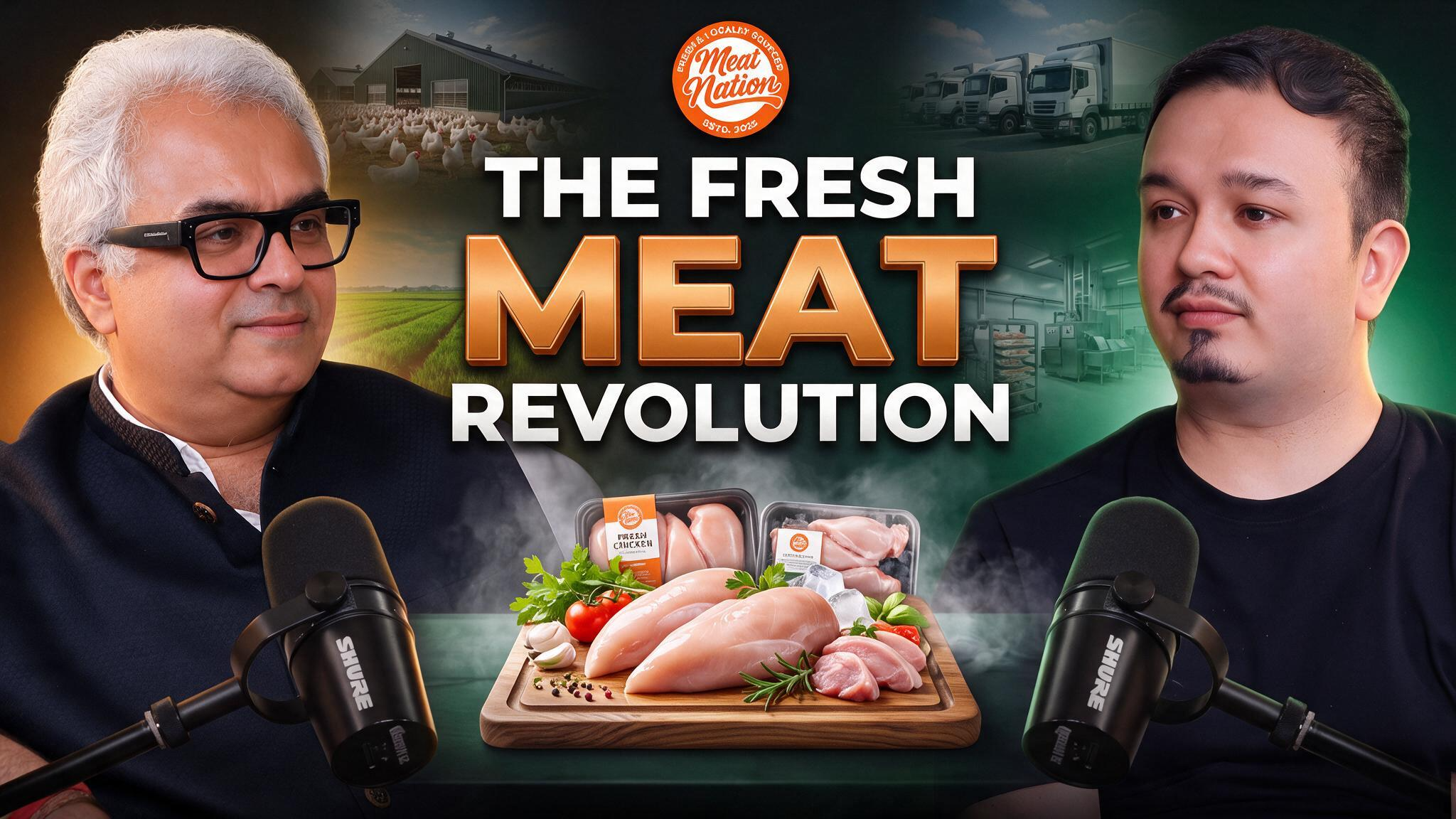
On this episode of The HJ Show, host Harsh Joshi sits down with Mr. Rohit Khanna for a conversation that covers far more than just meat delivery — it is a masterclass in spotting an underserved market, building a process-driven business from scratch, and why the first three years of any venture require complete, undivided commitment.
A Journey That Started with Fish
Rohit’s entrepreneurial story does not begin with a business school plan or a startup idea. It begins in the 10th standard, with an aquarium. What started as a hobby — keeping pet fish at home — quickly caught the attention of his father’s friends. He started making aquariums for others, then word spread, and what was a hobby became a small business. By the time he and his brother opened a proper aquarium shop, they were also supplying to government offices across Gujarat.
That first experience taught him something that runs through everything he has built since: turn what you know and love into something people genuinely need.
After the aquarium business, he moved into warehousing and eventually into the restaurant business — where he would spend the next eleven years. He built multiple restaurant outlets, won six consecutive Times Food Awards for Best Non-Vegetarian Restaurant, and developed a deep understanding of the food supply chain from the inside.
The Gap Nobody Was Solving
It was those eleven years in restaurants that exposed the problem Meat Nation was built to solve. Every time Rohit needed to source fresh, quality chicken or mutton for his kitchens, it was a challenge. The meat market in India — and particularly in cities like Ahmedabad — remains largely dominated by small, unorganised local sellers. No cold chain, no hygiene standards, no consistency, no transparency about sourcing.
Rohit saw that this was not just a restaurant problem. It was a consumer problem. Every household that cooked non-vegetarian food was navigating the same uncertainty — buying from a local butcher or a wet market without knowing whether the meat was fresh, how it was handled, or whether antibiotics and chemicals had been used in the supply chain.
Meat Nation was his answer to that problem.
What Meat Nation Actually Does
Meat Nation is an Ahmedabad-based fresh meat, chicken, egg, and fish delivery brand — serving both home customers and restaurant clients across the city, from Satellite and Vastrapur to Prahladnagar, Bopal, and beyond. The brand delivers antibiotic-free, chemical-free, fresh meat with a supply chain that Rohit describes as entirely transparent — customers and restaurant owners are actively invited to visit the processing facility and see how everything works.
The product range covers chicken in multiple cut options, mutton, eggs, duck, turkey, quail, and fresh fish — catering to halal, jhatka, and other religious and dietary requirements across Ahmedabad’s diverse consumer base.
What makes Meat Nation genuinely different is the process behind every delivery. Rohit explains it in detail in the episode — and it is not a simple operation.
The process starts at 11pm every night, when restaurants submit their next-day orders. From there, the procurement team heads to farms to pick up live birds based on those specific orders. The meat is brought to the processing facility, handled under cold chain conditions, and delivered in temperature-controlled vehicles at between 5 and 10 degrees. By 9:30 to 10am, deliveries are already underway.
For home customers, the process is just as structured. Orders can be placed on the Meat Nation website with delivery slots available every two hours throughout the day — and customers can schedule orders up to thirty days in advance.
The Cold Chain Nobody Talks About
One of the most important points Rohit makes in the conversation is about the cold chain — something most meat buyers in India have never even thought about. Protein degrades rapidly at room temperature. If chicken is transported or stored above the required temperature range for even two hours, quality begins to deteriorate. Most local butcher shops have no cold chain infrastructure at all.
Building and maintaining that cold chain — with dedicated vehicles, a temperature-controlled processing unit, and timed delivery slots — is one of the most significant investments Meat Nation has made, and one of the clearest reasons why the brand’s quality is consistently different from what most Ahmedabad consumers are used to.
Building Trust in an Unorganized Market
Trust is the central challenge of the meat business, and Rohit is candid about it. Many customers do not know how to evaluate the quality of what they are buying. Many have had bad experiences with a product they thought was low quality — when in reality, they had simply bought the wrong cut or a poorly handled product. Meat Nation’s response to this is transparency: invite people in, show them the process, let the facility speak for itself.
Today, Meat Nation has grown from a three-person team to a twenty-five-person operation, with repeat customers, restaurant clients, and a pipeline of businesses joining because they can see how the supply chain works. The next cities on the expansion roadmap are Baroda and Surat — but Rohit is clear that the Ahmedabad system needs to be fully optimised before the brand scales outward.
The Lesson That Applies to Every Business
The episode ends with Rohit’s advice to aspiring entrepreneurs — and it is as practical as everything else he has said. Build a timetable and follow it as a process. Have a Plan B before you need one. Do not walk into a business thinking you already know everything. And above all, give the first three years everything you have — no festivals, no shortcuts, no distractions.
Time is money. It always has been.
Watch the full episode of The HJ Show with Rohit Khanna on YouTube, or listen on Spotify and Amazon Music.

