
There is a version of the NEET and JEE preparation story that everyone knows. The long hours. The coaching institute fees. The family sacrifices. The hope placed on a single exam. And then there is the version nobody talks about publicly — the student who is burning out quietly, the parent whose pressure is doing more damage than any distraction, the relationship at 16 that derailed six months of preparation, and the drop year that turned into two, then three, with no honest conversation happening anywhere in between.
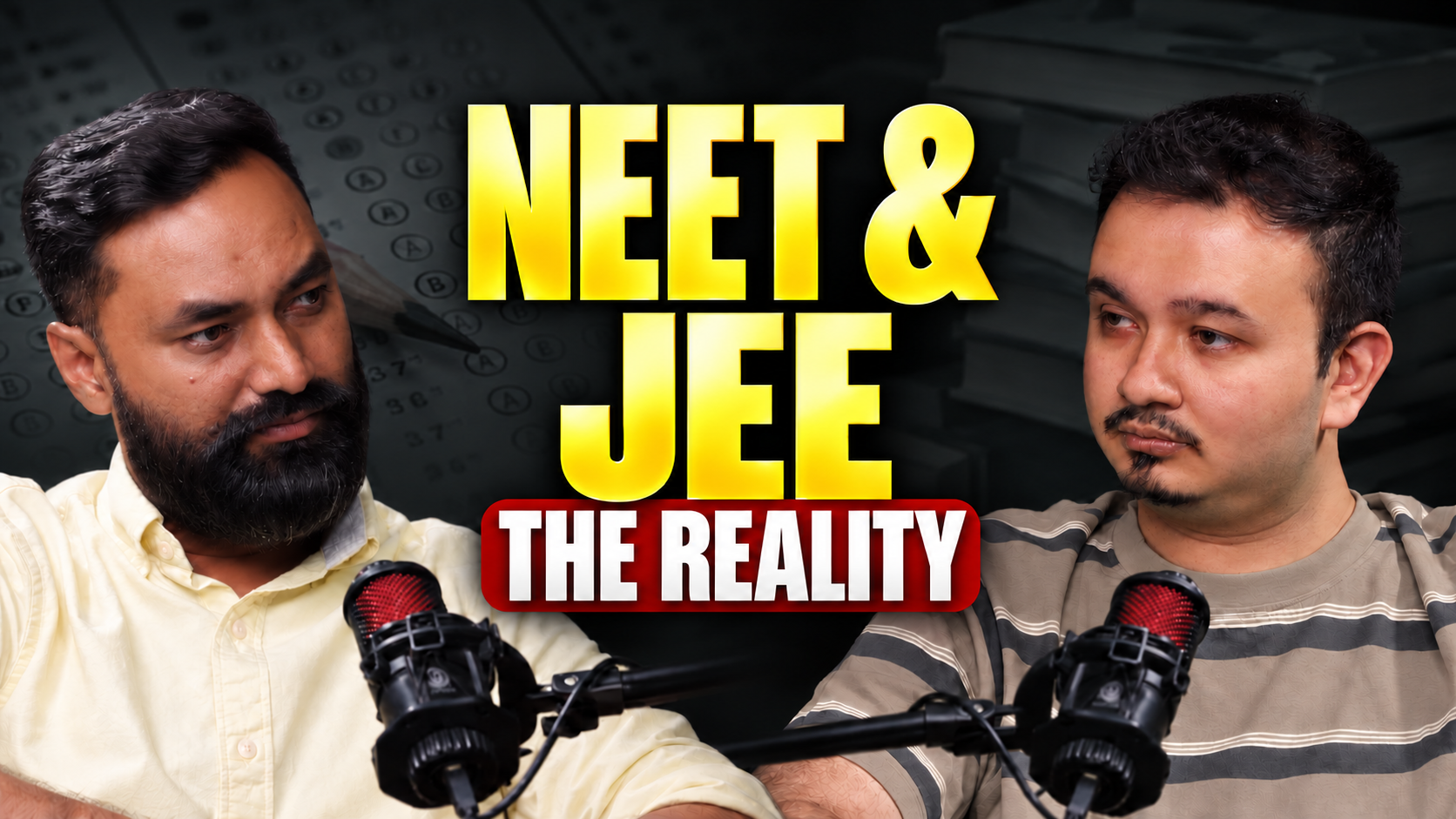
Abhishek Kumaar — known to his students as AK Sir — is the Founder of Gurukulum Academy and one of the most grounded Chemistry educators working with students today. In this episode of The HJ Show, he did something rare: he spoke with complete honesty about what ten years in classrooms have actually taught him. Not about Chemistry. About students. About parents. About the system. And about what it will take to stop losing young people to a crisis that is hiding in plain sight.
What Has Actually Changed in GenZ Students
AK Sir opens with an observation that anyone working in education today will recognise immediately. The students sitting in front of him today are fundamentally different from the students he began teaching a decade ago — not in intelligence, not in ambition, but in one specific and critical capacity: the ability to focus.
Attention spans have shortened. Patience has become scarce. The ability to sit with a difficult problem for twenty minutes without reaching for a phone — the basic cognitive muscle that all serious study requires — has weakened across the board. This is not a moral judgement. It is a structural consequence of the information environment these students grew up in. Infinite scroll, instant gratification, algorithms designed to keep the eye moving — these are not neutral background conditions. They have reshaped the way young brains process sustained effort.
The implication, AK Sir points out, is that before a student can address syllabus, they often need to address focus. And most coaching systems are not built to do that.
Boards vs Entrance Exams — The Balance Nobody Teaches
One of the most practically useful parts of this conversation is AK Sir’s framework for managing the dual pressure of board exams and entrance exam preparation simultaneously. For most students, these feel like competing demands pulling in opposite directions — and without a clear strategy, one invariably suffers at the expense of the other.
His approach is straightforward but rarely taught: understand the overlap, prioritise it relentlessly, and stop treating them as separate projects. The conceptual foundation required for JEE Chemistry and the board syllabus are not as different as students fear. The difference is the depth and application required. Build the foundation once, deeply, and it serves both.
Relationships at 16-17 — The Conversation That Needed to Happen
The most candid section of this episode addresses something that coaching institutes never put in their orientation packets: relationships. Students at 16 and 17 are forming their first significant romantic attachments. These are not trivial. They occupy enormous cognitive and emotional bandwidth — bandwidth that is then unavailable for the three to four hours of focused daily study that NEET and JEE preparation demands.
AK Sir shares a real case — a student he counselled through a heartbreak during their preparation year. The student’s performance had dropped sharply. A parent had noticed but assumed the cause was laziness. The actual cause was emotional overwhelm. AK Sir’s intervention was not to dismiss the relationship or lecture the student. It was to sit with them, acknowledge what they were going through, and then help them build a path back to stability. The student completed their preparation. They wrote the exam.
The point is not that relationships are the enemy of study. The point is that pretending they do not exist — the approach most parents and educators default to — leaves students entirely alone with a problem that does not go away when ignored.
The NEET Paper Leak and Student Suicides — An Honest Take
AK Sir does not sidestep the most painful subject in Indian education in recent years. The NEET paper leak controversy shook the confidence of hundreds of thousands of students who had spent years preparing in good faith. And the student suicides that have accompanied the pressure of these exams represent a failure that the system has not yet fully reckoned with.
His take is direct: when the integrity of the exam itself becomes questionable, the psychological damage to students extends far beyond the result. They are not just disappointed. They are betrayed. The contract — work hard, prepare honestly, trust the process — has been broken by the very institution that was supposed to uphold it. Rebuilding that trust requires more than administrative corrections. It requires a public acknowledgement of what students have been put through.
Drop Years — The Honest Conversation
On the question of drop years, AK Sir is measured and clear. One drop year, used with genuine intention and a specific plan, can be productive. Two drop years require a serious reassessment. Three or more, without a structural change in approach, almost never produce a different outcome — because the problem is rarely more time. It is usually something else: a wrong strategy, unaddressed emotional challenges, misaligned motivation, or — most commonly — parental pressure that has convinced the student they have no other acceptable path.
Parental Pressure, Toxic Comparison, and the Relatives
The conversation on parental pressure is where AK Sir is most direct. The well-meaning parent who checks marks daily, compares their child to the neighbour’s son who got into AIIMS, and responds to every setback with escalating anxiety — that parent, however loving their intention, is actively working against their child’s performance. Anxiety is contagious. Students absorb the emotional state of the home. A household running at chronic stress produces a student who cannot access the calm focus that deep study requires.
And the relatives — the aunts and uncles who ask at every family gathering what the student’s rank is, what their plan is, whether they are confident — AK Sir has a simple and accurate name for this: toxic comparison. It serves no one and damages many.
The Engineer-Doctor Obsession — Why India Needs to Change
AK Sir invokes 3 Idiots not as nostalgia but as unfinished business. The film made its argument in 2009. Seventeen years later, the engineer-doctor obsession has not meaningfully loosened its grip on Indian middle-class aspiration. Students who would flourish in design, in literature, in psychology, in skilled trades, in entrepreneurship — are instead sitting in NEET coaching for four years because no other path has been made visible or acceptable to their families.
His formula is the one the film articulated: interest plus potential equals right career. Both variables matter. Interest without aptitude leads to frustration. Aptitude without interest leads to burnout. When both are present — when a student is genuinely drawn to something they are also good at — the energy of preparation changes entirely.
Plan A, B, C, D — What Every Student Deserves
AK Sir ends with a framework he gives every student he works with: Plan A, B, C, D. Not as a signal that they should not aim high, but as a signal that they should not aim with one eye. A student who has thought through multiple paths — who knows what they will do if NEET does not go as planned, who has explored adjacent options, who understands that one exam result does not close every door — is a student who can prepare with genuine confidence rather than paralysing fear.
That confidence, he says, actually improves performance. It removes the desperation from the process. And desperation, in an exam hall, is the enemy of clarity.
This episode of The HJ Show is available on YouTube, Spotify, JioSaavn, Apple Podcasts, Amazon Music, and all major podcast platforms. Follow AK Sir on Instagram

