There is a story that Sahadevsinh Parmar tells with quiet honesty. It is the story of a Sunday evening when he sat at home with nothing left in his pocket — not enough for dinner, only enough for tea. That was before 13 outlets. That was before the viral WhatsApp message. That was before Capsule Pharmacy became one of Gujarat’s most recognized generic medicine pharmacy chains.
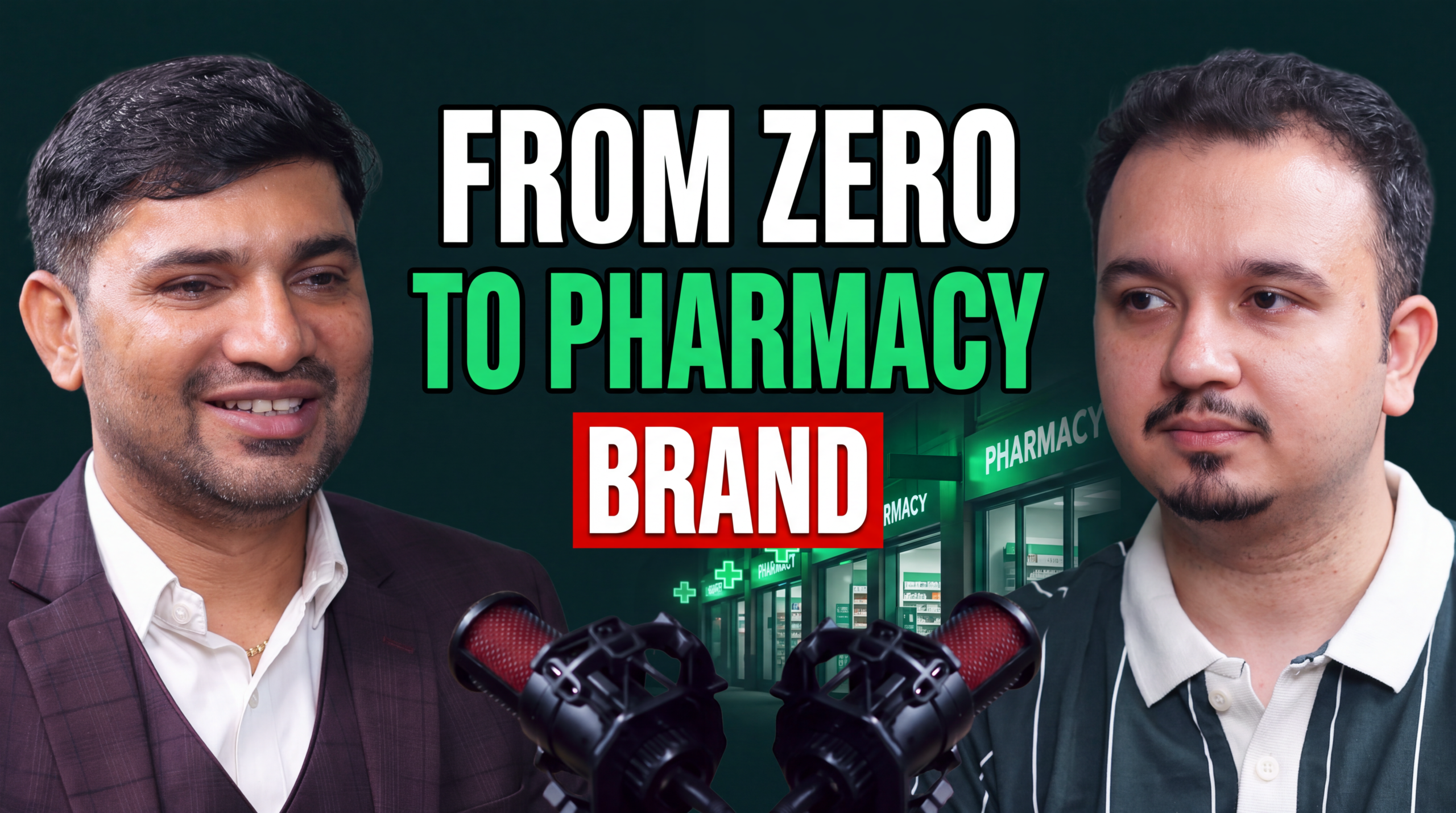
This is the episode that covers everything — failure, restarts, medicine awareness, and the business opportunity inside India’s pharmacy sector.
Two Ventures Before the One That Worked
Sahadevsinh’s entrepreneurship journey did not start with a pharmacy. It started in a college classroom in Chandigarh.
After completing his B.Pharm from L.M. College of Pharmacy — one of India’s top three pharmacy colleges — and his M.Pharm from Punjab University Chandigarh, he cleared GPAT with an All India Rank of 3. Instead of taking the standard postgraduate path, he used that rank to build something. He started GPAT coaching classes inside his college classroom, charging students ₹300 per head. Within the first year, students from his batch made it into GPAT’s top 100 ranks. That credibility was enough to launch Pharma Gleams — a formal coaching centre in Chandigarh Sector 15. The centre ran from 2011 to 2018, scaling to 250–300 students in its first year.
But the entrepreneurial mind does not stop at one idea. Around 2013, with the internet beginning to open up in India, Sahadevsinh launched Tajastuff.com — an online fruits, vegetables and grocery delivery platform. This was before BigBasket. This was before Jio. The Android app and website were built and live before the ecosystem was ready for them. Payments were not mainstream. Internet penetration was thin. The startup ran from 2013 to 2015 and eventually shut down — not for lack of vision, but for lack of timing and funding. He sat in conclaves alongside Paytm’s Vijay Shekhar Sharma and Snapdeal’s Kunal Bahl while pitching, but the round never came together.
By 2015, Sahadevsinh had moved back to Ahmedabad and taken a year to think clearly about what came next.
The Day With Only Enough for Tea
In May 2016, he and his wife — who had seven years of pharmacy operations experience — opened the first Capsule Pharmacy outlet in Bopal, Ahmedabad. They sat at the counter themselves. He did home deliveries by hand and marketed door to door. There were days when the door stayed open and no customer came. And then there was a day — a real one — when there was nothing left for dinner.
That is not the inspiring part. The inspiring part is what came next.
One Sunday, sitting at home, Sahadevsinh wrote a WhatsApp message comparing the price of regular branded medicines with generic alternatives. He sent it to roughly fifty loyal customers. By the next morning, the message had reached 8–10 lakh people. He arrived at his store on Monday to find a queue of 30–40 people outside — waiting before he had even unlocked the door. News channels picked it up. The store that had once waited for one customer could not keep up with the demand.
Monthly sales jumped from ₹1.5–2 lakh to ₹8–10 lakh within months. Within six months of that moment, he bought his first car — from his own profits.
What Generic Medicine Actually Means
The question most people have but rarely ask clearly: what is a generic medicine?
Sahadevsinh explains it this way. When a pharmaceutical company researches and develops a new molecule, it receives a 14-year patent. During that period, only that company can manufacture and sell it. That research cost — years of trials, animal studies, four phases of human testing — is built into the price.
Once the patent expires, any company can manufacture the same molecule under a different brand name. They do not need to repeat the full research. They only need to pass bioavailability testing. The molecule is identical. The quality is identical. The legal standard is identical. But the cost of making and distributing it is significantly lower — no MR salaries, no commission chains, no marketing budgets embedded in the price. That is why the same tablet that costs ₹250 in a branded generic version costs ₹20 in a plain generic version. Same content. Same effect. Different price.
The ₹700 Patient and Why This Matters
One story from the episode captures the purpose of Capsule Pharmacy in a single moment.
A patient walked in with his family. The doctor had prescribed a 5-day course. The estimate from the pharmacy came to ₹1,400. The patient had ₹700 in his pocket — including money for the auto ride home.
He asked for two days of medicine instead of five.
Sahadevsinh’s team offered an alternative: the same prescription in generic versions came to ₹400–450. The full 5-day course. Within his budget. With money left over. The patient took the complete treatment. And this — Sahadevsinh says — is the moment he is reminded why the generic pharmacy model matters.
The Danger of AI Self-Medication
The episode also goes deep into a growing problem: people using AI to self-diagnose and then walking into pharmacies with a medicine list they found online.
Pharmacists can tell the difference. AI serves the same set of medicines to everyone with the same stated symptom. But bodies are different. Allergies are different. Existing conditions are different. What works for one person can harm another. And some medicines are habit-forming. The risk of self-medication — especially from an AI search — is not theoretical. It shows up at the counter daily.
The Franchise Opportunity
For aspiring entrepreneurs, Capsule Pharmacy launched its franchise model in 2023. Two formats are available.
FOCO — Franchise Owned Company Operated — is for investors with no pharmacy background. Investment ranges from ₹25 lakh to ₹60 lakh depending on the outlet’s location and size. The company handles everything: staff, operations, marketing, pre-opening and post-opening campaigns. The investor receives a minimum 12% yearly return, with higher-performing outlets delivering 24–30%.
FIFO — Franchise Invested Franchise Operated — is for those with a pharmacy background who want to run their own outlet. The franchise fee is ₹2.5–5 lakh plus GST. The franchisee invests in the outlet setup, runs operations, and receives full support from Capsule Pharmacy — staff training, stocking guidance, marketing, expiry returns, and non-moving stock management. Royalty is 2–2.5% of sales, charged only once the outlet is in profit.
FOCO is currently available in Ahmedabad. FIFO is available across Gujarat and other states.
The Evergreen Business
Medicine is a daily need. It does not slow down in a recession. It does not wait for market conditions. That is what makes pharmacy — particularly generic medicine pharmacy — one of the most stable sectors in India.
Sahadevsinh Parmar’s story is not about luck. It is about the kind of continuous effort that makes one moment — one WhatsApp message, one Sunday evening — feel like luck when it finally lands.
The full conversation is on The HJ Show.

