
The question is everywhere.
Is IT still a safe career in 2026?
Is AI replacing developers?
Why are so many freshers struggling to get placed despite having degrees?
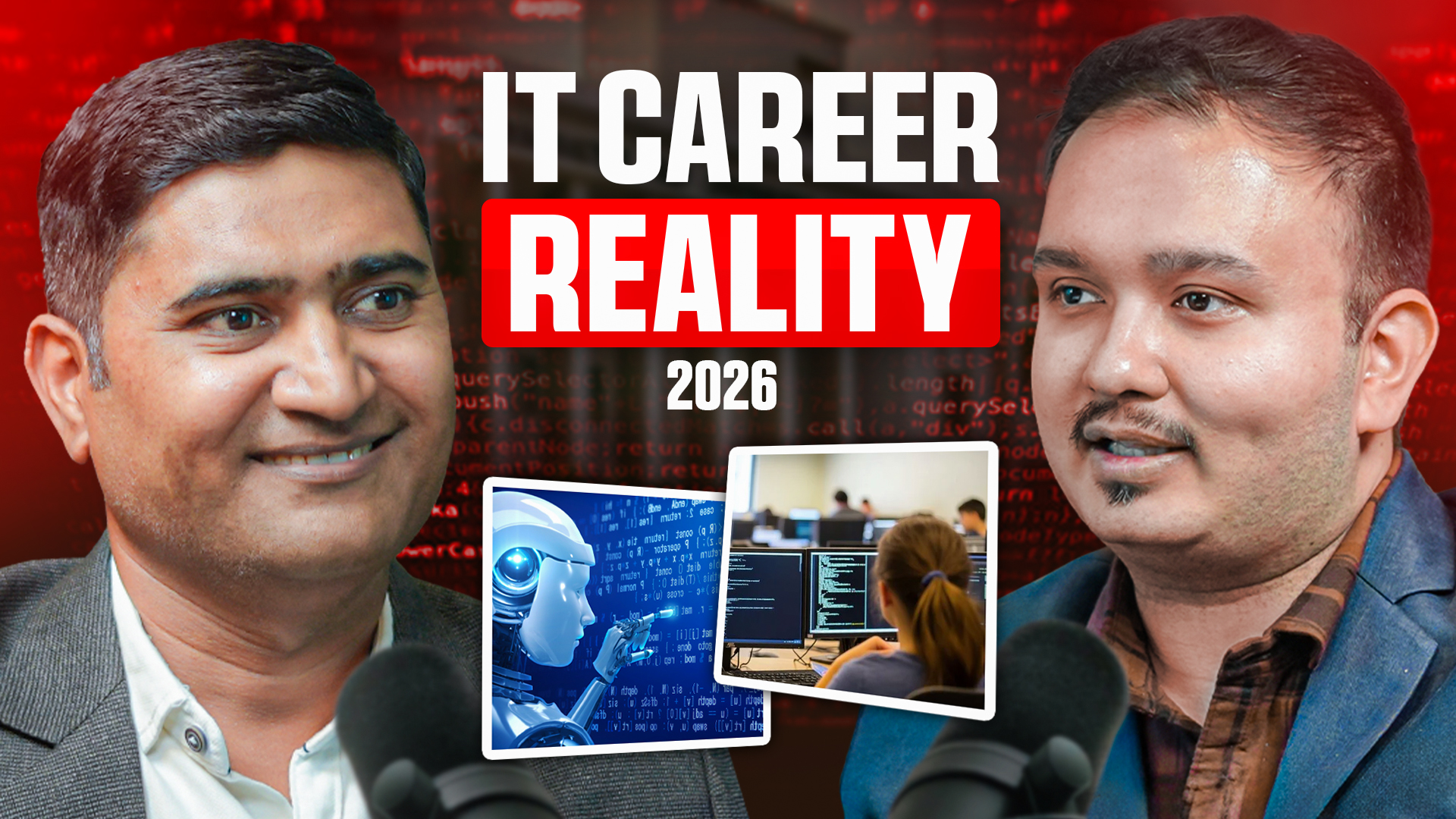
In the latest episode of The HJ Show, host Harsh Joshi sits down with Dilip Makwana, Co-Founder of ExcelPTP and Director at Amar Infotech, to decode the real ground reality of IT careers in 2026.
This is not a fear-based discussion. It’s a clarity-driven one.
Let’s break down the key insights from this powerful conversation.
The Big Question: Is IT Still a Safe Career?
The IT industry is not dying.
But it is evolving — fast.
Over the last few years, especially post-pandemic, the tech industry saw massive hiring waves followed by layoffs and restructuring. Add AI into the mix, and uncertainty increased.
However, according to Dilip Makwana, the problem is not “lack of IT jobs.”
The real problem is lack of job-ready skills.
Companies are still hiring. Projects are still running. Startups are still being built. But the expectations from candidates have changed.
The IT industry no longer rewards basic theoretical knowledge. It rewards applied skill, adaptability, and problem-solving ability.
Is AI Replacing Developers?
One of the biggest fears among students today is:
“Will AI take my job?”
AI tools like ChatGPT, GitHub Copilot, and automation platforms have changed workflows. But they have not eliminated the need for developers.
Instead, they have:
• Increased productivity expectations
• Reduced repetitive manual work
• Raised the skill benchmark
AI is not replacing skilled professionals.
AI is replacing average performance.
Students who rely entirely on AI without understanding fundamentals will struggle. But those who learn how to use AI strategically will have an advantage.
The future is not “AI vs Developers.”
The future is “Developers who use AI vs Developers who don’t.”
Why Freshers Are Struggling with Placements
One of the most important parts of the discussion was placement reality in India.
Every year, thousands of students graduate with IT degrees. Yet many remain unemployed or underpaid.
Why?
Because there is a massive gap between college curriculum and industry requirements.
Colleges often focus on outdated syllabus, theoretical exams, and marks. Meanwhile, companies look for:
• Practical project experience
• Real-world problem solving
• Understanding of tools & frameworks
• Communication skills
• Adaptability
A degree might get you an interview.
Skills get you the job.
This is where many freshers make mistakes. They focus on certification collection instead of capability building.
Skill vs Degree: What Do Companies Actually Want?
Another major insight from the episode was the Skill vs Degree debate.
While degrees are important for credibility and basic eligibility, companies ultimately hire for contribution.
Employers ask:
Can you solve real problems?
Can you work in a team?
Can you deliver value from Day 1?
Candidates who build live projects, internships, freelance experience, or portfolio-based work stand out immediately.
In 2026, employability will depend more on execution ability than academic percentages.
Coding vs Non-Coding Career Paths
Many students believe IT means only coding.
That is not true anymore.
The tech ecosystem today offers multiple career paths, including:
• Web Development
• App Development
• UI/UX Design
• Quality Assurance
• DevOps
• Cloud Engineering
• Data Analytics
• Cybersecurity
• Project Management
• Digital Product Roles
Even non-IT graduates can enter technology roles if they build the right skills.
The key is clarity.
Instead of following trends blindly, students must identify their interest areas and build structured learning paths.
The Placement Myth: 100% Guarantees?
Another sensitive topic discussed was the “100% placement” claim many institutes promote.
Students and parents often fall for marketing promises without understanding the structure behind them.
The reality is:
No institute can guarantee placement without student effort.
Placement is a combination of:
• Skill development
• Mock interviews
• Portfolio building
• Communication training
• Industry exposure
Institutes can provide training and opportunities. But the final responsibility lies with the student’s consistency and preparation.
Blindly trusting marketing claims can lead to disappointment. Research, ask questions, and understand the process before enrolling anywhere.
How Freshers Should Use AI Tools
AI tools are powerful.
But they must be used wisely.
Instead of copying code blindly from AI tools, students should:
• Use AI to understand concepts
• Debug errors
• Generate practice problems
• Explore alternative approaches
AI should enhance learning — not replace thinking.
The biggest danger is dependency without understanding.
The biggest opportunity is productivity with knowledge.
Is IT Saturated in 2026?
The IT field is competitive — yes.
But saturated? Not exactly.
Technology continues to evolve. New tools, platforms, and digital solutions are emerging every year. Businesses are becoming more tech-driven, not less.
However, the era of “easy entry with basic knowledge” is over.
Today’s IT career demands:
• Continuous upskilling
• Real-world exposure
• Strong fundamentals
• Professional communication
• Adaptability
Students who treat IT as a shortcut to quick money may struggle.
Students who treat IT as a serious profession with long-term commitment will thrive.
Final Advice for Students & Parents
If you are a student planning your career in IT:
Do not chase hype.
Do not fear AI.
Do not depend only on college.
Focus on:
Building real skills
Working on live projects
Improving communication
Understanding industry needs
Learning consistently
If you are a parent:
Guide your child toward skill-building, not just degree completion.
The IT industry still offers massive opportunities — but only for those who are prepared.
Conclusion: The Future Belongs to the Prepared
The IT industry in 2026 is not unsafe.
It is simply more demanding.
AI is not the enemy.
Complacency is.
Degrees are not useless.
But they are not enough.
In this eye-opening episode of The HJ Show, the conversation with Dilip Makwana provides practical clarity instead of fear-driven speculation.
Watch Full Episode On YouTube
If you are serious about building a tech career, this episode is a must-Watch.
Because the future does not belong to those who panic.
It belongs to those who prepare.

