
Every year, thousands of students score above 85–90% in board examinations. Their report cards reflect consistency, discipline, and academic strength. Yet, when the same students appear for competitive exams like NEET or JEE, many fail to qualify.
Why does this happen?
Is time management really the biggest problem? Or is there a deeper issue—lack of direction, clarity, and strategy?
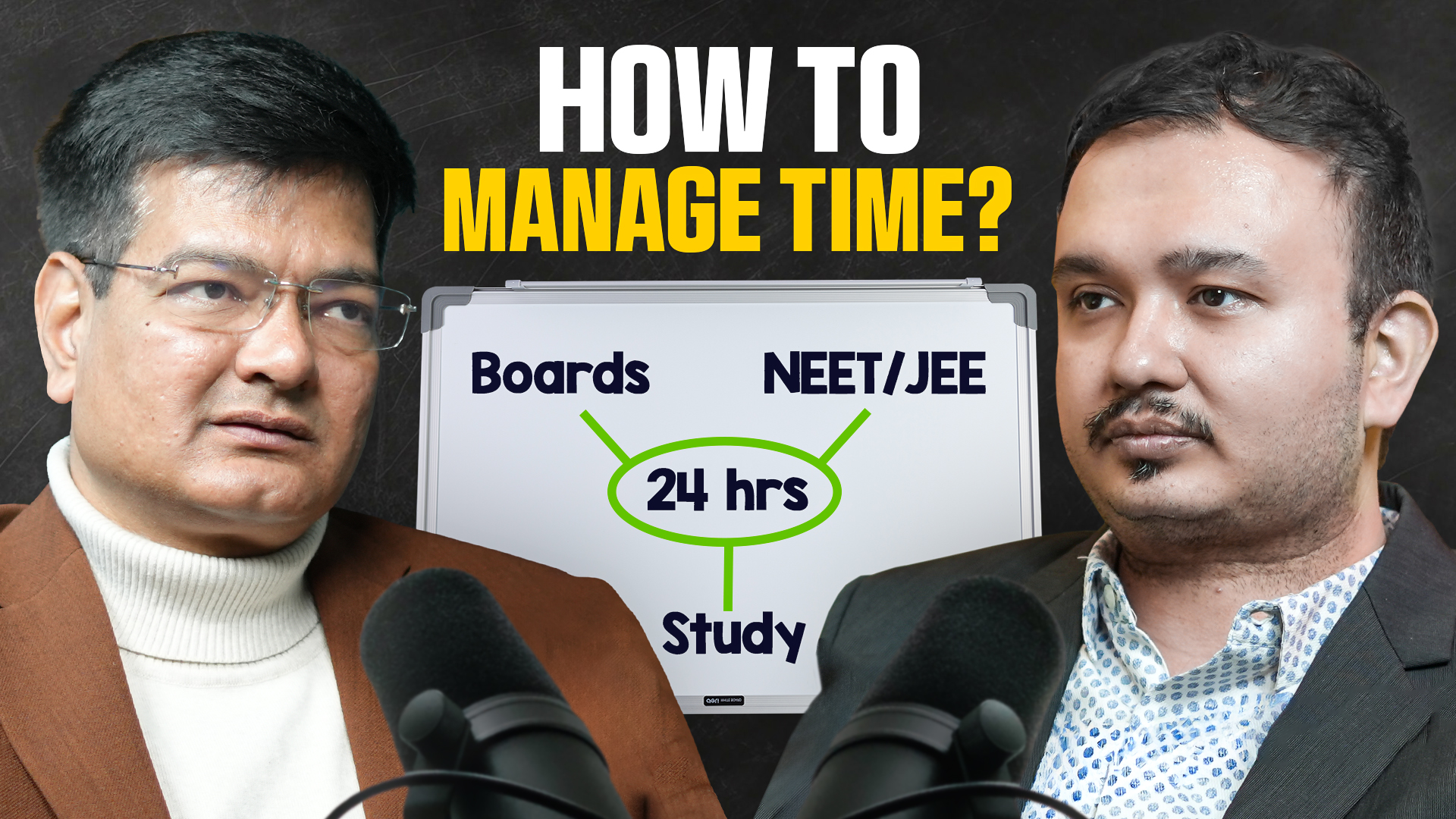
In a powerful and eye-opening conversation on The HJ Show, educationist Sushil Naikk (Ph.D), Founder of Shri Renuka Institute, shares insights drawn from over 25 years of mentoring medical aspirants. With decades of experience guiding NEET students and shaping academic journeys, he breaks down the real gap between board success and competitive exam performance.
This article captures the key lessons from that discussion—essential reading for NEET aspirants, JEE aspirants, students from Class 8–12, and parents navigating the confusing coaching ecosystem.
The Fundamental Difference: Boards vs Competitive Exams
The first and most important distinction lies in the nature of preparation.
Board exams are largely descriptive. They reward presentation, structured answers, memorization, and clarity of theory. A student who understands concepts reasonably well and writes neatly can score high marks.
Competitive exams like NEET and JEE, however, are objective and analytical. They demand speed, precision, conceptual depth, and the ability to eliminate wrong options under time pressure. Memorization alone is insufficient. Application is everything.
Many students prepare for NEET with a “board mindset.” They read chapters thoroughly but solve limited MCQs. They feel confident because they understand the theory—until the exam tests them in ways they never practiced.
That is where results begin to differ.
Is Time Management the Real Problem?
Students often say, “I don’t get enough time.”
But according to Dr. Naikk, time is rarely the core issue. The real issue is energy management and direction.
A student may sit with books for eight hours, but how many of those hours are productive? Mental fatigue, mobile distractions, multitasking, and lack of clarity reduce efficiency. It is not about studying longer; it is about studying smarter.
Energy peaks and dips during the day. High-focus tasks like solving MCQs or revising difficult concepts should align with peak energy periods. Passive tasks like reading or note-making can be done during lower-energy slots.
Students who understand this perform consistently better than those who simply count study hours.
How Many MCQs Should a Student Solve Daily?
One of the most common questions aspirants ask is about the ideal number of MCQs per day.
The answer is not a fixed number. It depends on the stage of preparation, conceptual clarity, and exam proximity. However, what truly matters is consistency and quality of analysis.
Solving questions without reviewing mistakes is ineffective. Every wrong answer is feedback. Students must maintain an error log, revisit weak areas, and reattempt incorrect questions.
Competitive exams reward those who practice application daily—not those who only read theory repeatedly.
The “Gen Z Super Car Without GPS” Analogy
In the podcast, Dr. Naikk uses a powerful metaphor: today’s students are like super cars without GPS.
They are intelligent, fast learners, technologically skilled, and resourceful. But many lack direction. With unlimited access to information, online lectures, AI tools, and coaching options, they feel overwhelmed.
Without proper mentorship, they keep switching strategies—new books, new teachers, new apps. This constant shift prevents depth.
Clarity of path is more important than speed.
School, Tuition, and Self-Study: Finding Balance
A common struggle for students is managing school responsibilities alongside coaching classes and self-study.
Many overburden themselves with multiple tuitions, believing more teaching equals better results. In reality, excessive classes reduce time for revision and practice.
Self-study is irreplaceable. No teacher can study on behalf of a student.
A structured routine with limited, focused guidance often produces better results than juggling multiple coaching centers without reflection time.
The Crash Course Illusion
As exams approach, many students enroll in crash courses hoping for a miracle turnaround.
Crash courses can help in revision and strategy refinement. But they cannot compensate for years of weak foundation.
Competitive exams test cumulative understanding. If fundamentals are shaky, last-minute acceleration rarely works.
Preparation must begin early, especially for serious NEET or JEE aspirants.
Why Many Students Quit After Class 11
Class 11 is often the breaking point.
Students who scored well in Class 10 suddenly face tougher concepts, higher competition, and pressure from peers and family. When initial test scores drop, confidence declines.
Some begin to doubt their capabilities. Others feel isolated. Without emotional support and structured mentorship, many lose motivation and quietly withdraw from serious preparation.
The transition from school-level excellence to competitive rigor requires mental resilience—not just intelligence.
Interest vs Trend: Choosing the Right Career
Another critical issue discussed is career selection based on trends rather than genuine interest.
Many students choose NEET because it is prestigious. Others choose engineering because friends are doing it. Social pressure heavily influences decisions.
But competitive exams demand sustained effort for years. Without intrinsic interest, consistency becomes difficult.
Parents must avoid imposing their unfulfilled dreams on children. Instead, they should guide exploration and encourage informed decisions.
Single Mentorship vs Multiple Coaching
In today’s ecosystem, students often attend different teachers for each subject and sometimes multiple teachers for the same subject.
While exposure can help, too many mentors create confusion. Different teaching styles, different problem-solving methods, and varying advice can overwhelm students.
A consistent mentorship structure builds stability. Trust and clarity reduce anxiety.
AI Tools: Helpful or Harmful?
Technology and AI are powerful tools for learning. They can clarify doubts instantly, generate practice questions, and simplify complex topics.
But uncontrolled usage becomes distraction.
Short-form content, constant notifications, and excessive screen time fragment attention spans. Students must use technology intentionally—not impulsively.
Digital discipline is becoming as important as academic discipline.
The Power of Mock Tests
Mock tests are not merely for score evaluation. They are psychological training.
Students must simulate real exam conditions, analyze time allocation, identify weak chapters, and improve question selection strategies.
Fear of exams reduces when exposure increases. Regular testing builds confidence and composure.
Avoiding mock tests due to low scores only delays improvement.
Foundation Matters: Start Early
Preparation for competitive exams ideally begins between Classes 8 and 10—not in terms of pressure, but in terms of conceptual clarity.
Strong basics in Physics, Chemistry, Biology, and Mathematics make advanced preparation smoother. Students who build habits early—daily revision, curiosity-driven learning, and problem-solving practice—adapt more easily in Classes 11 and 12.
Career Options Beyond NEET
Not qualifying in NEET does not mean life ends.
There are numerous healthcare and science-related careers beyond MBBS: dentistry, physiotherapy, pharmacy, biotechnology, research, allied health sciences, and more.
Success is not limited to a single entrance exam.
Students must broaden their understanding of career pathways rather than attaching self-worth to one result.
Final Advice for Aspirants and Parents
The gap between board success and competitive exam results is not about intelligence. It is about strategy, mindset, direction, and consistency.
Students must:
-
Focus on conceptual clarity.
-
Practice MCQs daily.
-
Analyze mistakes deeply.
-
Manage energy, not just time.
-
Seek stable mentorship.
-
Build emotional resilience.
Parents must:
-
Offer support, not pressure.
-
Encourage clarity over comparison.
-
Understand the difference between school exams and competitive exams.
Full Episode
Competitive preparation is a marathon—not a sprint.
With the right guidance, structured effort, and mental strength, students can bridge the gap between board excellence and competitive success.
And sometimes, all it takes is the right direction for that super car to finally reach its destination.

